Fresh Crab T-Shirt Design: An Embroiderer's Honest Review
First Glance and the Mood It Sets
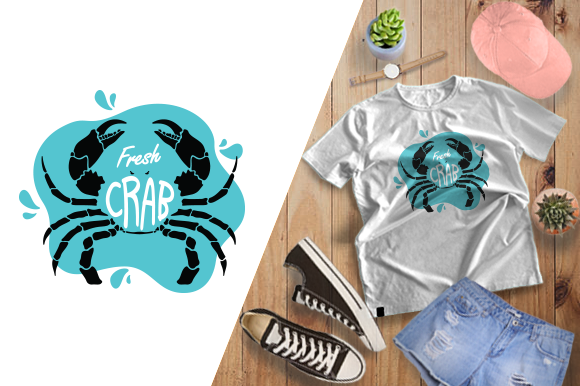
When I opened the T-shirt Design - Fresh Crab file, the first thing that hit me was how clean and uncluttered the composition feels. This is not one of those overwrought crustacean illustrations that tries to show every leg segment and antenna whisker in exhausting detail. Instead, it leans into bold, confident shapes that read instantly—even from a few feet away. For anyone who has ever digitized a design and watched it stitch out only to realize the details turned into a muddy mess, that instant readability matters.
The crab has personality without being cartoonish. There is a slight energy in the way the claws are posed, almost like the creature is ready to scuttle sideways into a beach bag or onto a kitchen apron. It feels coastal, a little playful, but grounded enough to work on products meant for adults and kids alike. I could immediately picture it on a canvas tote slung over a shoulder at a farmers' market, or centered on a soft cotton tea towel hanging in a vacation rental kitchen.
From a purely visual standpoint, the design sits in that sweet spot where graphic meets approachable. The vector shapes are clearly defined, and the description confirms this is made with 100 vector shapes resizable. That matters enormously when you are thinking beyond the screen and into thread, fabric, and a sewing machine needle moving at several hundred stitches per minute.
Why Vector Quality Changes the Embroidery Game
As someone who has spent years converting artwork into machine embroidery design files, I cannot overstate how much the source material dictates the final stitched outcome. The fact that T-shirt Design - Fresh Crab comes with AI 10, EPS 10, PDF, SVG and PNG Transparent 300dpi files means you are not fighting a low-resolution JPEG with fuzzy edges and mystery pixels hiding in the corners. You have crisp paths to work with, which makes the digitizing process smoother and the resulting stitch file cleaner.
When I loaded the SVG into my design software to trace a quick stitch mockup, the paths separated logically. The claws, the body shell, the legs—each element held its own space without awkward overlaps or gaps that would later need manual cleanup. For an embroidery digitizer, that is the difference between a twenty-minute setup and a two-hour wrestling match with node points. If you are a small business owner who outsources digitizing, handing over a file this clean can also reduce your per-design conversion cost, because the digitizer will not charge extra for heavy reconstruction work.
The 100 vector shapes claim seems plausible here. Everything feels deliberately placed, not auto-traced from a raster image. That gives me confidence the design will scale without losing integrity, whether you are stitching it at three inches wide for a baby bib or seven inches across for the back of a denim jacket.
A Real Project That Started With a Crab
Let me ground this in something real. A few weeks ago, a friend who runs a small coastal boutique asked me to create a limited run of embroidered kitchen towels and matching aprons for her summer collection. She wanted something seafood-related but not a lobster—too expected. A crab felt fresher, a little quirkier. She also needed the design to work on both light cream linen and a deep navy cotton twill, because her shop aesthetic mixes light and dark textiles.
I pulled up the T-shirt Design - Fresh Crab artwork and did a quick color inversion test. The description states it is possible and easy change color for dark t-shirt, and that held up in practice. Swapping the body fill from a warm rust to a light sand tone—so it would pop against navy fabric—took roughly thirty seconds in vector software. I ran a stitch simulation on both colorways, and the contrast held beautifully in each case. The crab's silhouette remained unmistakable.
That project ended up being a quiet bestseller at her shop. Customers picked up the towels as hostess gifts, and a few asked if the same crab could go onto a child's sun hat. The design's flexibility made it possible to say yes without hesitation.
Where This Design Feels Most at Home
Not every piece of artwork belongs on every product, and part of being a responsible designer is knowing when to say no. Here is where I would confidently place T-shirt Design - Fresh Crab and where I would pause.
It thrives on products with a flat or gently curved surface area. Think tote bags, aprons, pillow covers, tea towels, the chest area of a sweatshirt, the front panel of a cap if kept scaled modestly, and the center back of a denim jacket. The design has enough visual weight to anchor a product without needing additional text or embellishment, though it pairs nicely with simple coastal script if you want to add a location name or a short phrase underneath.
On baby clothing and nursery decor, the crab takes on an almost storybook quality. Stitch it in soft coral and cream threads on a white cotton blanket, and it feels gentle and whimsical. On a patch, the bold shape holds up exceptionally well because the legs create a natural boundary that a satin-stitch border can follow cleanly.
I would be cautious on extremely textured fabrics like thick terry cloth, where the finer leg details could lose definition. Similarly, on highly stretchy performance wear, the design would need extra stabilizer planning to prevent distortion. It is not impossible—just requires a test stitch on scrap fabric first, which is advice I give for every single design I work with.
Stitchability and Practical Challenges
Let me walk through what happens when this design meets an embroidery machine. The overall shape is compact and cohesive, which is a gift for stitch planning. The crab's body lends itself naturally to a fill stitch with a subtle texture, while the claws and leg joints can take a clean satin stitch outline that gives definition without adding excessive density. Because the vector artwork already separates elements cleanly, the stitch order logic flows well: body first, then claws, then the leg details on top.
One thing I always check is how a design handles the transition between adjacent color areas. In this crab, the claw sections sit close to the body shell. If the stitch density is too high where those zones meet, you can end up with a stiff, bulletproof patch of thread that feels awful against the skin and puckers after the first wash. A skilled digitizer will reduce density slightly in those overlap zones, and the vector source file makes those boundaries crystal clear to work with.
The legs are the make-or-break detail. They are thin enough that at very small sizes—say under two inches wide—they risk becoming thread blobs on anything less than a perfectly stabilized fabric. For small hoop sizes like a 4x4, I would scale the crab to at least 2.5 inches wide and run a running stitch underlay beneath the leg satin stitches to anchor them. If you are stitching on a curved surface like a cap, keep the design away from the side seams where the fabric pulls unevenly.
Color Choices That Make or Break the Look
The description highlights the ease of changing colors for dark t-shirts, and I want to expand on why that feature matters in real embroidery life. A crab rendered in deep reds and burnt oranges looks fantastic on natural linen, cream cotton, and light heather gray. But drop that same red crab onto a black hoodie and it disappears into the fabric, leaving your customer squinting and questioning the craftsmanship.
With the T-shirt Design - Fresh Crab artwork, you can quickly test a lightened color palette in your vector software before committing thread to fabric. I tried a version in soft coral and sandy beige for dark backgrounds, and another in bright paprika and cream for light backgrounds. Both read clearly at a distance, which is the benchmark I use for whether a design belongs on retail-ready products. If I have to explain to a customer what the stitched shape is supposed to be, the design has already failed its first job.
One thread-color tip: consider using a slightly lighter shade for the claw undersides to create a sense of dimension. The vector shapes give you the guide for where those color breaks should fall, and that small contrast makes a noticeable difference in the finished embroidered product.
Using the Design Files Beyond Embroidery
Since this is a Print Templates product in the Graphics category, the files are not limited to stitch work. For craft business owners who sell across multiple channels, that versatility adds real value. You can use the same crab artwork to create printable mockups for your Etsy listing photos, design matching paper tags for your handmade products, or produce a coordinating screen-printed version of the design for items where embroidery is not practical, like thin jersey t-shirts.
I have used similar vector designs to build cohesive brand assets for a product line: the embroidered version goes on premium tote bags and aprons, while the printed version appears on thank-you cards and packaging inserts. Customers notice that kind of attention to detail, and it quietly builds trust in your small shop product presentation.
The PNG Transparent 300dpi file is especially handy for quick digital previews. I can drop it onto a photo of a blank tote bag, adjust the perspective slightly, and show a client roughly what the finished piece will look like—all before a single stitch is sewn. That pre-visualization step has saved me from more than one costly design revision.
What Crafters and Sellers Should Actually Know
If you are an Etsy seller, a craft fair vendor, or someone building a small handmade brand around coastal or culinary themes, this design earns its place in your asset library. The crab motif has broad appeal without feeling generic, and it avoids the seasonal trap of being only useful during summer. Seafood lovers, beach house owners, marine biology enthusiasts, and anyone with a soft spot for coastal living will connect with it year-round.
Before you list a finished item for sale, do your due diligence. Test stitch the design on the exact fabric you plan to use rather than assuming the first run will be perfect. Check the thread color contrast under natural light and indoor lighting, because what looks crisp on a screen can wash out under warm bulbs. Wash the test piece at least once to see how the thread holds up and whether the fabric puckers around the stitch zone. These steps are not busywork—they are what separate a professional handmade product from something that looks like a practice piece.
Also, confirm the licensing terms before you sell finished goods or include the design in a digital embroidery file bundle you intend to resell. The product description lists the included file formats clearly, but it is your responsibility to verify what commercial usage is permitted for physical products and derivative works.
The Honest Bottom Line
After evaluating hundreds of artwork files for embroidery suitability over the years, I have developed a short mental checklist. Does the design read clearly at multiple sizes? Does it separate into logical color zones? Can it survive the transition from smooth vector art to textured thread on fabric? Will a customer smile when they see it stitched on a finished piece?
The T-shirt Design - Fresh Crab checks all four boxes. It is not trying to be the most detailed marine illustration ever drawn, and that restraint is precisely what makes it work for machine embroidery. The shapes are confident, the mood is warm, and the practical flexibility—especially the easy color adaptation for dark garments—makes it useful across a wide range of embroidery projects. Whether you are stitching a single personalized gift for a friend or producing a batch of twenty custom apparel pieces for a boutique order, this crab is ready to do the work.
Take the time to test it on your chosen fabric, pair it with the right stabilizer, and dial in the stitch settings that suit your machine. The artwork is strong enough to reward that effort with a finished product that looks polished, intentional, and genuinely appealing. In a market flooded with forgettable graphics, that kind of result is worth pursuing.